


Mahama Calls for African Health Sovereignty at WHA"

President John Dramani Mahama delivered a forceful, policy-driven address at the 79th World Health Assembly at Geneva-Switzerland , urging sweeping reforms to the global health architecture and championing African health sovereignty.

Mahama raised alarm over declining global health financing and the withdrawal of international aid, citing recent cuts to U.S. assistance and reductions in humanitarian funding.
He said Ghana has lost approximately $78 million in external health support, a shortfall affecting malaria, HIV/AIDS, maternal health and nutrition programmes.
Calling for an end to donor dependency, Mahama promoted the Accra Reset Initiative as a pathway to “health sovereignty” for African countries. He described sovereignty as the ability to finance national health systems, regulate standards, manufacture medicines locally and manage health data — not isolationism.

Ghana’s domestic health reforms featured prominently in his remarks. Mahama highlighted the government's Free Primary Healthcare Program, which aims to remove financial barriers to preventive care, and the expansion and digitisation of the National Health Insurance Scheme (NHIS). He said the government has released an additional 3 billion Ghana cedis for healthcare investment and noted that the 2026 budget allocates 34 billion cedis (about $3.4 billion) to the sector, with expanded coverage projected to reach 20 million citizens.
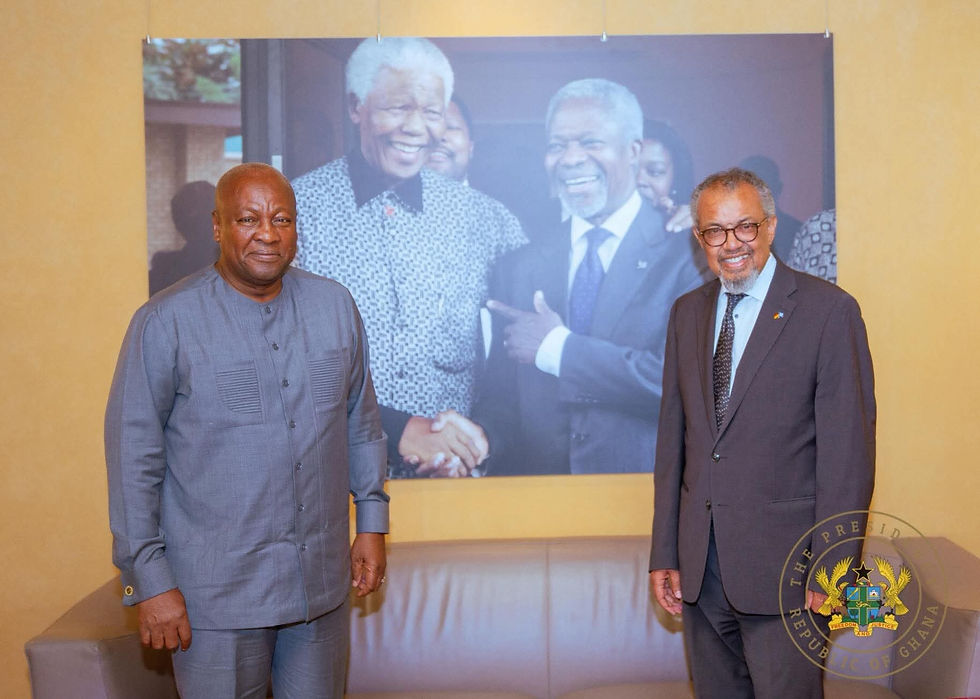
Mahama also announced the launch of the Ghana Medical Trust Fund, dubbed “Mahama Cares,” intended to support treatment for non-communicable diseases including cancer, kidney disease and cardiovascular conditions.
On global reform, Mahama issued a stark warning against superficial changes. He urged the World Health Organization and other institutions to undertake “fearless analysis” and resist protecting bureaucratic silos, invoking a Malian proverb to caution that reforms without real change would amount to “performing a ritual.” He praised WHO Director-General Tedros Adhanom Ghebreyesus for his support of Ghana’s healthcare initiatives.
As part of the Accra Reset Initiative, Mahama outlined three operational pillars:
A High-Level Panel on Reform to independently examine the global health architecture.
A Reform Internal Observatory to harmonise strategies among major global health institutions such as WHO, GAVI and the Global Fund.
HINGE (Health Investment National Gateway and Enablement System), aimed at catalysing investment in local pharmaceutical manufacturing and bio-innovation.

Mahama underscored Africa’s disproportionate disease burden, noting the continent carries about 25% of global disease yet produces less than 1% of the world’s vaccines. He criticised the complexity of the current aid system, saying health ministers in developing countries expend excessive time preparing donor reports instead of strengthening primary healthcare delivery.
Concluding his address, Mahama appealed for bold, outcome-oriented reforms, arguing that the emerging global health order should be “defined by agency, not aid; by partnership, not paternalism.” He urged leaders to prioritise investment in practical healthcare delivery and to measure success by results in clinics rather than declarations at global conferences.


Comments